Recipe: Breakfast, Brunch, Meal Prep, Hands-Off
How to Cook Perfect Bacon in the Oven (So Crispy)
By Food Menu Journal Team · Researched October 2026 · Disclosure: This is a researched recipe guide, not a cook test report. The method, amounts, times, and temperatures below come from four published recipes: The Kitchn, Allrecipes, Serious Eats, and This Mess Is Ours. Where the sources disagree, on temperature, time, rack use, overlap, and storage, the disagreement is stated in the guide instead of hidden. No cook test is claimed. The sous vide Canadian bacon section found in the Serious Eats paste is a different dish cooked by a different method, so it is left out of this guide.
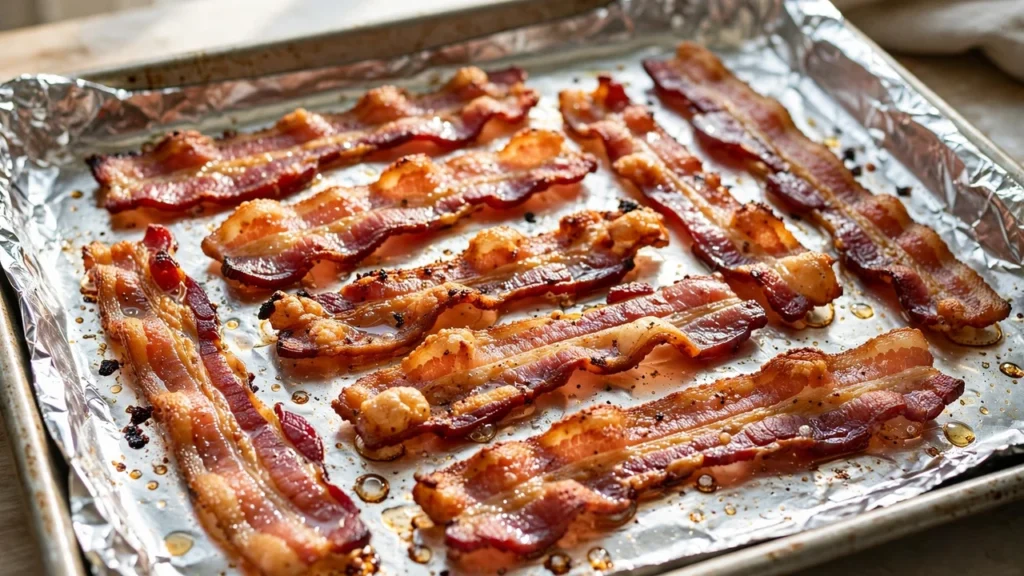
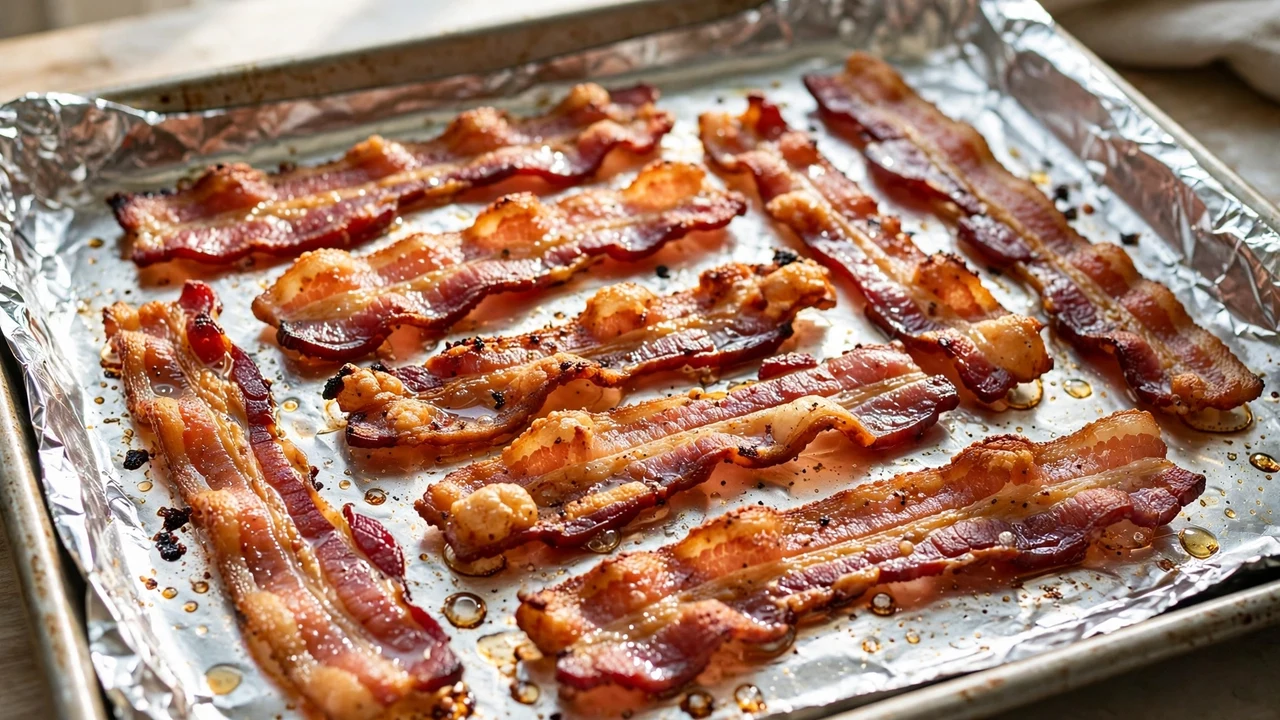
Oven bacon is the easiest way to cook a big batch of bacon: crispy, smoky strips, baked flat, with no flipping and no grease splattering on your skin, your clothes, or your kitchen. You lay the bacon on a lined baking sheet, put it in the oven, and set a timer. The strips bubble away in their own fat and turn deep golden-brown and crispy, while the stovetop stays free for everything else. It is the best method when you are cooking a pound or more, for a big Saturday brunch, for sandwiches and burgers, or for a week of easy meal add-ins. Four published recipes were compared, including a four-method test by Serious Eats, so you can pick the temperature, time, and setup that fits the bacon you like.
Recipe at a Glance
| Recipe | Perfect bacon in the oven, no flipping, no stovetop splatter |
| Main version | The Kitchn: 400F, middle rack, lined rimmed baking sheet, 12 ounces bacon |
| Prep time | 1 minute (The Kitchn); 5 minutes (Serious Eats, This Mess Is Ours) |
| Cook time | 12 to 18 minutes at 400F (The Kitchn); about 20 minutes at 425F (Serious Eats); 10 to 20 minutes at 400F (Allrecipes preheat method); 14 minutes from a cold oven at 425F (Allrecipes cold method); 15 minutes, usually 17 to 18 minutes for really crispy (This Mess Is Ours) |
| Total time | 13 to 19 minutes (The Kitchn, prep plus cook); 25 minutes (Serious Eats); 20 minutes (This Mess Is Ours) |
| Servings | 4 to 6 (The Kitchn, Serious Eats); 1 pack of bacon (This Mess Is Ours) |
| Oven temperature | 400F (The Kitchn, Allrecipes preheat method, This Mess Is Ours); 425F (220C) (Serious Eats, Allrecipes cold method). The sources disagree, and the difference is texture: lower is more tender, higher keeps more meaty chew |
| Pan | Rimmed baking sheet, 13 by 18 inch (Serious Eats), lined with parchment paper or aluminum foil with overhang on all 4 sides |
| Flipping | None. No source flips the bacon |
| Best for | Large batches, brunch crowds, BLTs and burgers, weekly meal prep |
Why We Made This Guide
Crispy, smoky bacon is one of life’s great pleasures, but standing over a hot stove dodging sputtering grease is not. The oven gives you both: the bacon and the calm. This guide exists because the sources do not fully agree, and the differences matter. One source says 400F, another says 425F. One says use a rack for extra crisp, another says do not bother with a rack at all. One says never overlap the slices, another says slight overlap is fine. Instead of picking one voice and hiding the rest, this guide lays out all four published methods side by side, with their times, textures, and cleanup, so you can choose with open eyes. Serious Eats tested four methods and four temperatures head to head, and The Kitchn re-tested its method twice, in 2019 and 2020, so the recommendations below rest on repeated testing, not one try.
Ingredients & Equipment
One ingredient does the whole job. No prices appear in any of the four sources, so none are listed here.
| Ingredient | Amount | Notes |
| Sliced bacon | 12 ounces (The Kitchn); 12 slices (Serious Eats); 1 pound thick-cut (Allrecipes cold method); 1 pack, not thick cut (This Mess Is Ours) | Regular or thick-cut. One pound of medium-thick bacon fits on one large baking sheet |
| Black pepper | To taste (This Mess Is Ours) | Optional, sprinkled over the strips before baking |
| Maple syrup or brown sugar | To taste (This Mess Is Ours) | Optional sweet twist, brushed or sprinkled on before baking |
| Equipment | Notes |
| Rimmed baking sheet, 13 by 18 inch | Large enough for one pound in a single layer. Use two sheets at once for more bacon |
| Parchment paper or aluminum foil | Line the sheet with overhang on all 4 sides to hold hot fat and make cleanup easy. Both work equally well |
| Metal cooling rack, oven-safe | Optional, for extra-crispy bacon. Must be oven-safe; a cookie cooling rack may not be |
| Tongs | To transfer hot bacon to paper towels |
| Paper towels | To drain the bacon and finish crisping |
| Fine-mesh strainer and heatproof container | Only if saving the bacon grease |
Our Review: How Each Method Turns Out
Based on the published testing notes, oven bacon is crispy, evenly browned, and flat, with no curling and no stovetop mess. The four methods below were all tested by Serious Eats at 425F, and the comparison table after them sums up the trade-offs. The rack question is the one real fight in the sources, and it is stated plainly: three sources recommend a rack for extra crisp, while Serious Eats says skip it.
Directly on the Baking Sheet: The Favorite
Serious Eats calls this the favorite method, and it is also the easiest. The bacon fries in its own fat as it cooks, which helps it cook evenly and protects it from drying out or turning leathery. The result is the crispest, most well-browned bacon of the four methods, crisp with a few lightly chewy bits, fatty areas that melt nicely as you chew, and even browning with a little buckling in the strips. Blotting on paper towels afterward is essential, but side by side the bacon tastes no greasier than the rack-cooked samples. Cleanup is very easy: one tray, or nothing to clean if you use foil.
On a Wire Rack: Extra Crisp, Hard Cleanup
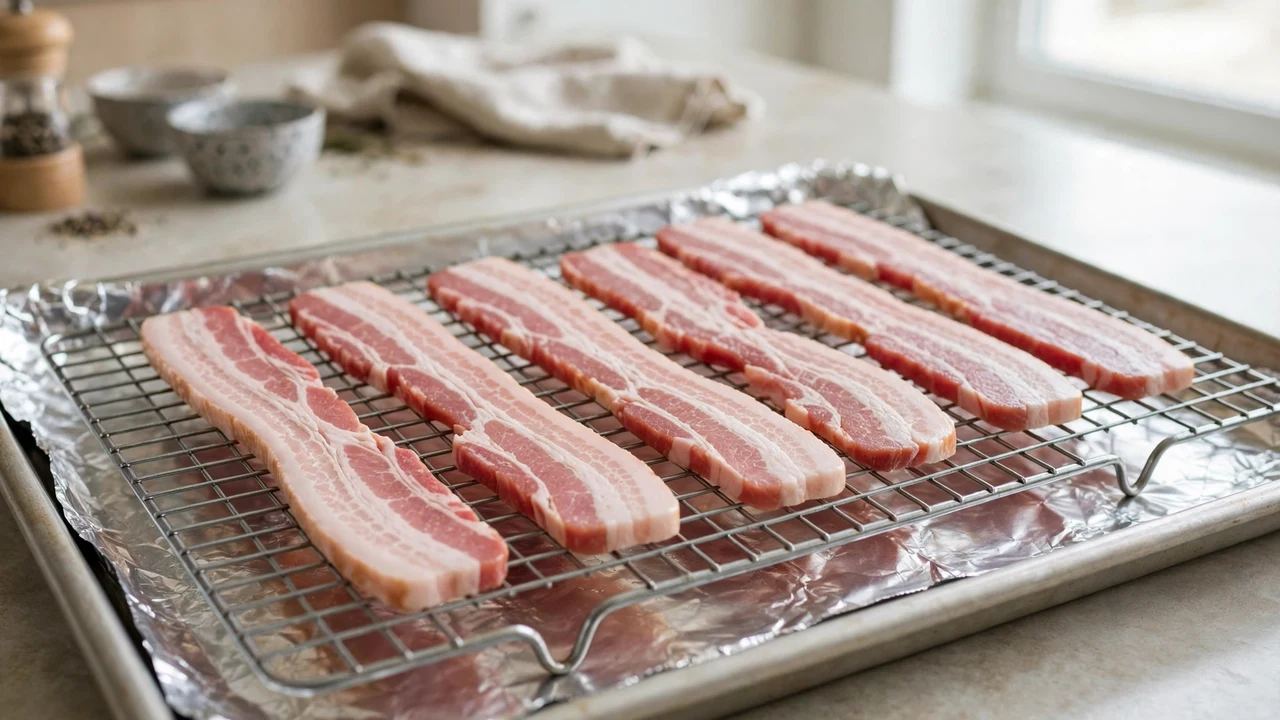
The Kitchn, Allrecipes, and This Mess Is Ours all recommend a rack for the crispiest bacon: lifting the strips lets them cook from all sides, lets the grease drip away, and keeps the bacon out of the fat. The Kitchn notes oven bacon keeps a bit of chewiness near the middle, especially thick-cut, and the rack fixes that for cooks who want crisp through and through. Serious Eats disagrees from its own side-by-side test: the rack bacon tasted no less greasy, some bits dried out and turned tougher and chewier, fatty areas browned before leaner areas, and the residue-encrusted rack was very difficult to clean, needing every intersection scrubbed. If you use a rack, accept the cleanup. If you skip it, you lose little, by the Serious Eats test.
On Crimped Foil: For Chewy-Bacon Lovers
Fold a sheet of aluminum foil accordion-style in 1-inch pleats, stretch it out on the tray, and fold up the edges to catch drips. The bacon sits raised like on a rack, with very easy cleanup. The result suits chewy-bacon lovers: a few crisp bits, but mostly meaty, with soft interiors, and lean bits that can border on tough when fully browned. Setup takes moderate time for the crimping. Allrecipes home cooks offer a quicker version: crumple foil and lay the bacon on it to hold it up out of the grease.
Between Two Baking Sheets: Flat Bacon for Sandwiches
Line a sheet with foil and parchment, lay the bacon on it, top with a second parchment sheet, and set a second baking sheet on top. The bacon stays completely flat and shallow-fries in its own fat, giving extremely well-rendered, evenly browned, very crisp strips that stack easily in BLTs and burgers and keep a bacon weave flat. The cost is time: about 25 to 30 minutes for thin-cut and 30 to 35 minutes for thick-cut, because evaporation is inhibited, and moderate cleanup since the top tray picks up a little grease.
A Note on Temperature
Serious Eats cooked bacon on crimped foil at four temperatures until crisp and well browned: 325F took 50 minutes, 375F took 35 minutes, 425F took about 20 minutes, and 475F threatened to burn in spots while staying undercooked elsewhere after 15 minutes. The lower-temperature bacon was more tender, nearly dissolving in the mouth, because longer cooking tenderizes the connective tissue. At 425F the bacon kept more meaty chew. The tester chose 425F, partly because 35 minutes is a long wait. The Kitchn and This Mess Is Ours stay at 400F with shorter times, which lands between those two textures.
| Method | Texture | Setup | Cleanup |
| Directly on the sheet | Crisp, a few lightly chewy bits, even browning | Very easy | Very easy |
| On a wire rack | Moderately crisp, a few tough chewy bits | Very easy | Very difficult |
| On crimped foil | Chewy, meaty, soft interiors | Moderate | Very easy |
| Between two sheets | Very crisp, evenly browned, completely flat | Moderate | Moderate |
Steps: How to Cook Bacon in the Oven
Step 1: Heat the Oven and Line the Pan
- Arrange a rack in the middle of the oven (The Kitchn). For a double batch, use two racks in the upper-middle and lower-middle positions (Serious Eats).
- Heat the oven to 400F (The Kitchn, This Mess Is Ours) or 425F (220C) (Serious Eats). This Mess Is Ours notes there is no need to wait for the oven to preheat fully before the pan goes in; putting the pan in as the oven heats helps render the fat more evenly.
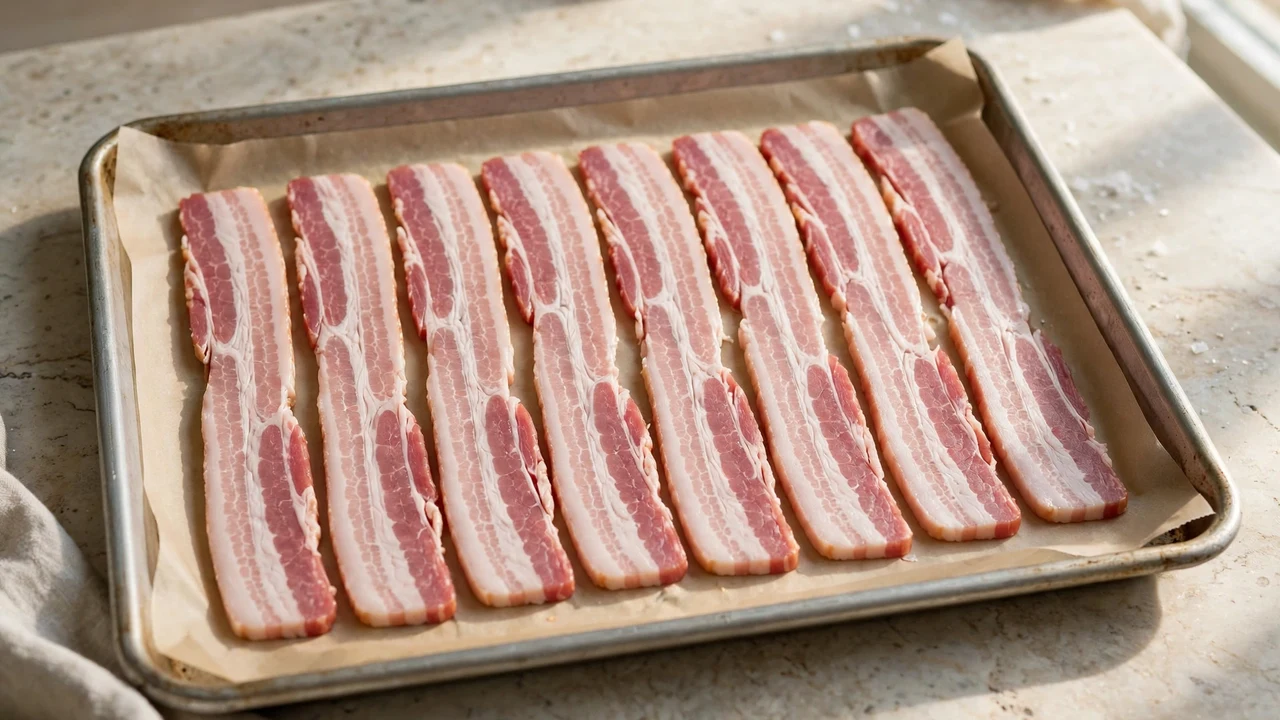
- Line a rimmed baking sheet with parchment paper or aluminum foil, making sure there is overhang on all 4 sides. Overlap a few sheets if needed to cover the pan fully. The overhang contains the hot rendered fat and makes cleanup easy.
- For the rack method, fit an oven-safe metal cooling rack over the lined sheet before arranging the bacon.
Step 2: Arrange the Bacon
- Arrange the bacon on the baking sheet, or on the rack if using one, in a single layer.
- The slices can be close together or touching, but do not let them overlap or they will stick together during cooking (The Kitchn). The Allrecipes cold method allows slight overlap, since the bacon shrinks as it bakes; Serious Eats says overlap as little as possible. When in doubt, keep slices separate.
- If seasoning, sprinkle black pepper over the strips now, or brush with maple syrup or sprinkle brown sugar for a sweet twist (This Mess Is Ours).
Step 3: Bake Until Deep Golden-Brown and Crispy
- Do not flip the bacon at any point. The oven heat cooks both sides.
- At 400F: bake about 14 minutes for regular bacon and 18 minutes for thick-cut bacon (The Kitchn). Begin checking after 12 minutes, since a less-than-full sheet cooks more quickly. This Mess Is Ours checks at 15 minutes and usually goes 17 to 18 minutes for really crispy bacon.
- At 425F: bake 10 minutes, rotate the pan, then bake 5 to 10 minutes longer for thin-cut or 10 to 15 minutes longer for thick-cut, until as browned as you like (Serious Eats).
- Flat sandwich method at 425F: bake 25 to 30 minutes for thin-cut or 30 to 35 minutes for thick-cut, with the second sheet on top the whole time (Serious Eats).
- Cold oven method: place the pan in a cold oven, heat to 425F (220C), and cook as the oven comes up to temperature for 14 minutes, or until cooked to your liking (Allrecipes, Joseph’s recipe).
- For a double batch at 425F, rotate the trays top to bottom and back to front halfway through, and allow 5 to 8 minutes extra (Serious Eats). With a convection setting, reduce total cooking time by a few minutes.
- The bacon fat will sputter and bubble as it cooks, but it should not splatter the way it does on the stovetop. If oven splatter worries you, lay a layer of foil over the bacon and remove it for the last few minutes for final crisping (Allrecipes home cook tip).
Step 4: Drain, Crisp, and Serve
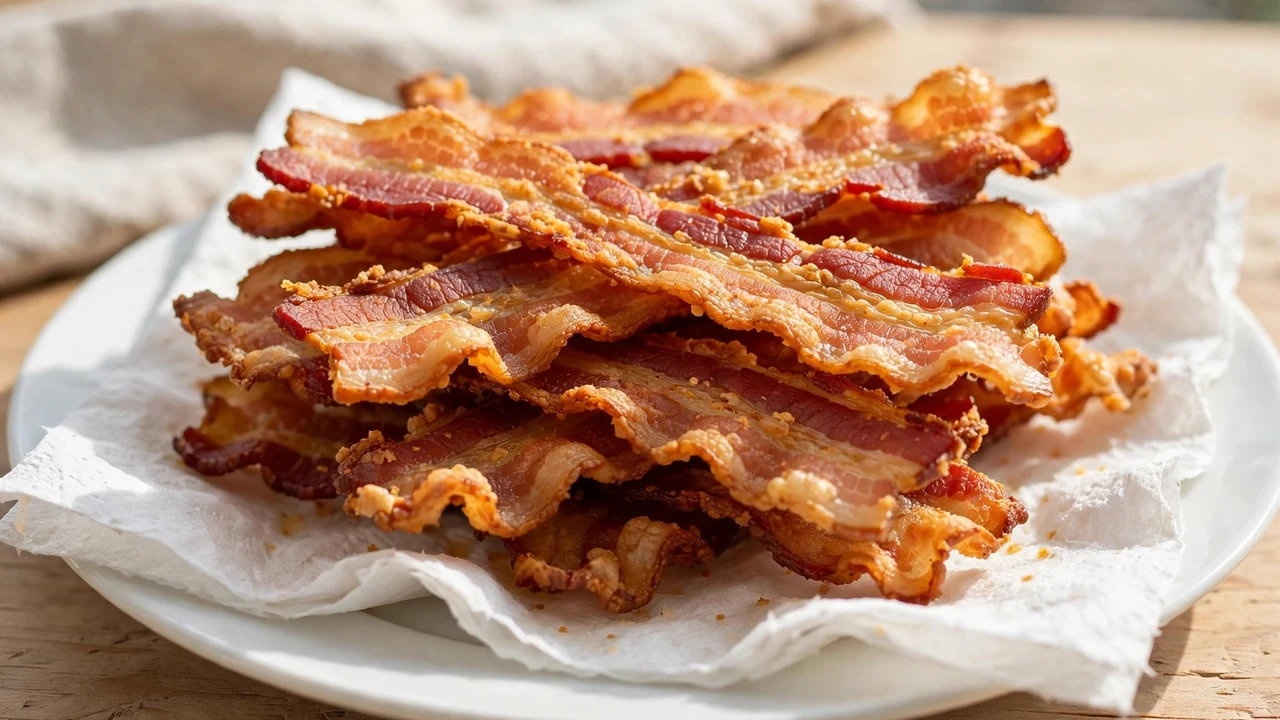
- Use tongs to transfer the bacon to a plate lined with paper towels to drain and finish crisping. Serve immediately (The Kitchn).
- For the cold oven method, let the bacon cool for 5 minutes on the paper towels so it crisps before serving (Allrecipes).
- What to do with the grease: to save it, let it cool slightly, pour it through a fine-mesh strainer into a heatproof container, and refrigerate (The Kitchn). To discard it, let it solidify on the baking sheet, then crumple the foil or paper around it and discard. Let the pan cool slightly before draining the fat, and just roll up the foil and toss it for the easiest cleanup (Allrecipes).
Picky Eats
Bacon is a single familiar ingredient, and the only real choice is texture: pull it earlier for chewy bacon, leave it longer for crispy through and through. The crimped foil method is the pick for chewy-bacon lovers, with mostly meaty strips and soft interiors. Seasoning stays optional and simple: plain, black pepper, or a sweet maple or brown sugar twist. Keep strictly to these sourced points: no child review exists in the four sources, so none is claimed here.
Parents’ Review & Family Tips
For families, the win is a hands-off crowd batch with no grease burns. The Kitchn calls oven baking the way to go for a pound or more at a big Saturday brunch or for a week of easy meal add-ins. Allrecipes frames it as the first job of a weekend morning: pan in a cold oven, then brush teeth and cook the rest of breakfast while the bacon takes care of itself. One pound fits one large sheet, and two sheets cook at once for a crowd. Leftovers reheat in the microwave or oven, so a Sunday batch covers weekday sandwiches, burgers, salads, and breakfast sandwiches: the sources name the BLT, bacon egg and cheese sandwich, bacon butty, ultimate bacon cheeseburger, and hash brown breakfast sandwich. Keep strictly to these sourced points: no parent review exists in the four sources, so none is claimed here.
Nutrition & Carbohydrate Information
Only Serious Eats publishes nutrition figures for its version, per serving, with 4 to 6 servings. The Kitchn shows a nutrition link but no values in the text used here, and Allrecipes and This Mess Is Ours publish no figures, so no nutrition is given for their versions and nothing is invented.
| Measure | Per serving (Serious Eats) |
| Calories | 108 |
| Fat | 8g |
| Carbohydrates | 0g |
| Protein | 8g |
What to Know Before Cooking
- Parchment paper and aluminum foil work equally well. The important variable is overhang on all four sides of the rimmed sheet, to contain hot fat and make cleanup easy (The Kitchn re-test, 2020).
- Use an oven-safe rack only. A rack made for cooling cookies may not be oven-safe.
- No two ovens bake at exactly the same temperature. Expect to test the method a couple of times to find the right time and temperature for your oven (Allrecipes).
- A less-than-full sheet cooks more quickly, so begin checking after 12 minutes even if the recipe says 14 to 18 (The Kitchn).
- At 475F the bacon threatened to burn in spots while staying undercooked elsewhere. Stay at 400F or 425F (Serious Eats).
- Let the pan cool slightly before draining the fat, and never pour hot grease into a container that cannot take heat.
- No rack? Crumple foil and lay the bacon on it to hold it up out of the grease, or make neat accordion folds instead (Allrecipes home cook tip).
- Storage advice disagrees: The Kitchn says refrigerate leftovers 1 week or freeze up to 3 months. This Mess Is Ours says an airtight container in the fridge up to 4 days. Both reheat in the oven; The Kitchn also allows the microwave, This Mess Is Ours also allows the air fryer.
Is It Worth It?
Yes, whenever you cook more than a few slices. The oven method is easy, hands-off, and completely splatter-free, with even cooking and flat strips that stack well. The direct-on-sheet method is the best balance: easiest setup, easiest cleanup, crispest results. The rack is worth it only if you want maximum crisp and accept a hard cleanup, by the Serious Eats test, though three other sources recommend it. The flat two-sheet method is worth its longer time only for sandwiches, burgers, and bacon weave. For one or two people, a skillet is easy enough, and the oven’s edge is the batch. Once you try the oven method, the sources agree, the stovetop version is hard to go back to.
FAQ
Do I have to flip the bacon in the oven?
No. None of the four sources flips the bacon. You lay the strips on the baking sheet, put the pan in the oven, and set a timer. The oven heat cooks both sides, and the strips bubble away with no splattering.
What temperature should I bake bacon at?
400F (The Kitchn, Allrecipes preheat method, This Mess Is Ours) or 425F (220C) (Serious Eats, Allrecipes cold method). Lower temperatures give more tender, nearly melting bacon with longer cooking; 425F keeps more meaty chew. Do not use 475F: Serious Eats found it burned in spots while leaving other parts undercooked.
How long does bacon take in the oven?
At 400F, about 14 minutes for regular bacon and 18 minutes for thick-cut, checking after 12 minutes (The Kitchn). At 425F, about 20 minutes total, or 10 minutes plus 5 to 15 more after rotating (Serious Eats). From a cold oven at 425F, 14 minutes as the oven heats (Allrecipes). The flat two-sheet method takes 25 to 35 minutes. Exact time depends on thickness and how crispy you like it.
Should I use a wire rack?
It depends on what you value. The Kitchn, Allrecipes, and This Mess Is Ours recommend an oven-safe rack for extra-crispy bacon that cooks from all sides with the fat dripping away. Serious Eats says do not bother: in its side-by-side test the rack bacon tasted no less greasy, some bits dried out, and the rack was very difficult to clean. Both views are stated in the guide.
How do I store and reheat leftover bacon?
The Kitchn: refrigerate 1 week or freeze up to 3 months, rewarm in the microwave or oven. This Mess Is Ours: airtight container in the fridge up to 4 days, reheat in a preheated oven or air fryer to restore crispness. The two storage times disagree, so both are stated here.
Related Food Guides
- Strawberry Icebox Cake Recipe Full Guide
- Banana Bread Recipe Ingredients, Steps, Nutrition & Tips (With Video)
- New York Food Map Easy Recipe, Ingredients, Steps & Nutrition
- Taco Bell Menu Prices, Calories, Recipe & Full Guide (2026)
Sources & Review Notes
Researched recipe guide. Method, amounts, times, and temperatures were taken from four published recipes: The Kitchn, “Perfect Bacon in the Oven” by Emma Christensen, updated December 19, 2025 (400F, 12 ounces, 14 and 18 minutes, rack tip, grease handling, storage, and the 2019 and 2020 re-test notes by Patty Catalano); Allrecipes, “The Easiest, No-Mess Way to Cook Bacon” by Vanessa Greaves, updated July 27, 2026 (cold oven method at 425F for 14 minutes, preheat method at 400F for 10 to 20 minutes, 11 reasons, and home cook tips); Serious Eats, “Baked Bacon for a Crowd Recipe” by J. Kenji Lopez-Alt, updated October 17, 2022 (four-method test, four-temperature test, 425F, 12 slices, flat method times, double-batch and convection notes, nutrition figures); and This Mess Is Ours, “Extra Crispy Oven Baked Bacon” (400F, 1 pack bacon, pepper, 15 to 18 minutes, storage, sweet twist). Disagreements between the sources are stated in the guide: temperature (400F vs 425F), time (12 to 18 minutes vs about 20 vs 25 to 35 flat), rack use (recommended by three sources, rejected by Serious Eats), overlap (never vs slight overlap allowed), and storage (1 week vs 4 days in the fridge). No prices appear in any source, so none are listed. The sous vide Canadian bacon recipe in the Serious Eats paste was excluded as a different dish. No cook test is claimed, and no figures were invented for versions that publish none.